Extended Surroundings
Wildfire-resilient design accounts for the site and its surroundings.
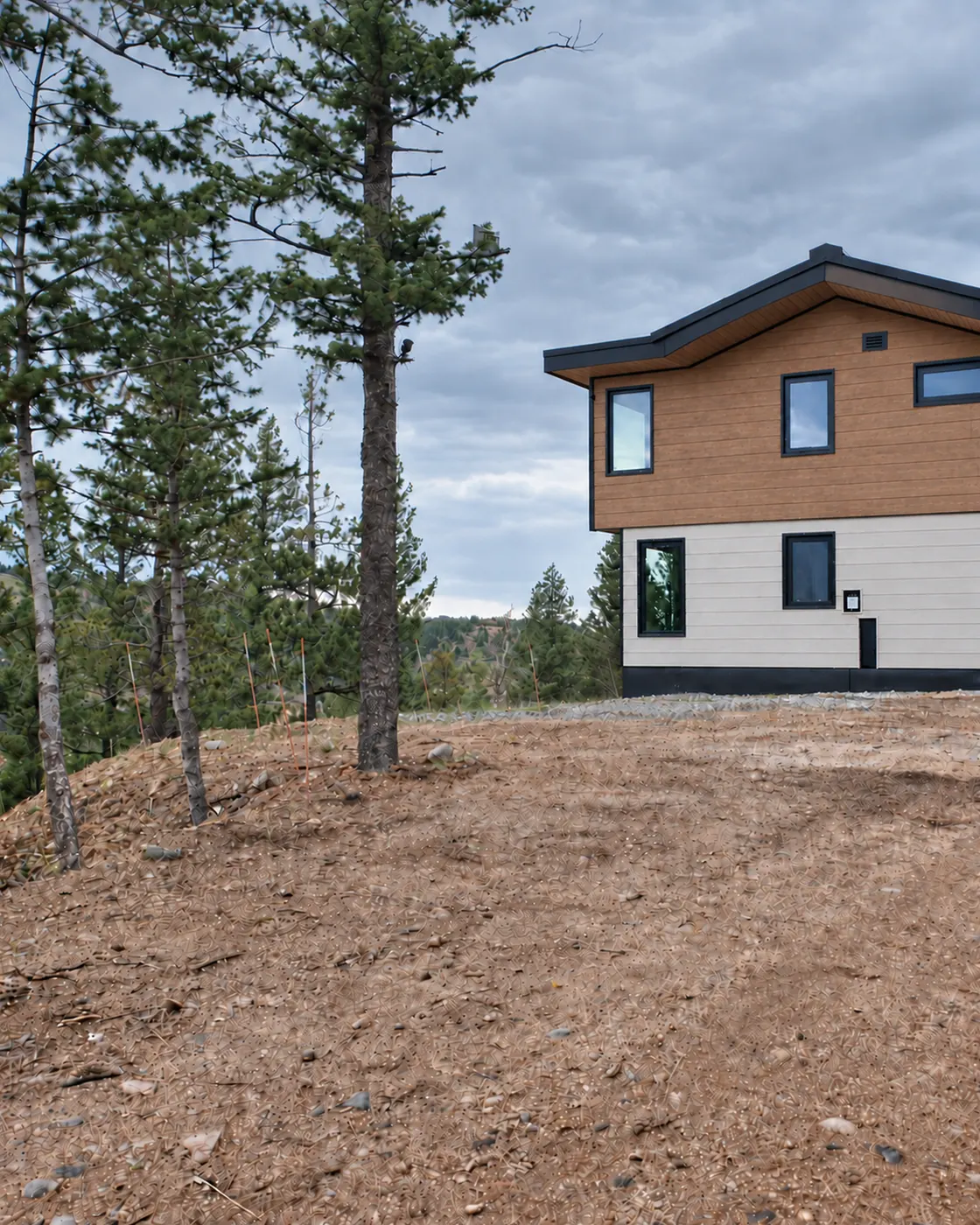
Vegetation, terrain, and nearby structures can influence how fire spreads toward a building. Conditions on and beyond the property shape its potential exposure to heat, flame, and embers.
Why it matters
Looking beyond the area immediately around a building helps explain how wildfire may approach it. Some of the conditions that influence that exposure are beyond the property owner’s control. Accounting for those conditions helps inform decisions about the building’s design and protection.
How it fails
- Fuel continuity allows fire to move toward the building. As fire spreads between combustible features, it can bring heat and flame closer to the structure.
- Surrounding conditions affect how fire approaches the building. Terrain and vegetation influence fire spread. Nearby structures can become additional sources of heat, flame, and embers if they ignite.
What works
- Manage fuel continuity across the property. Create separation between vegetation and other combustible features to interrupt fire pathways toward the building and reduce its potential exposure to heat and flame.
- Design for the conditions that cannot be changed. Account for terrain, neighboring properties, and other surrounding conditions when determining how the building should be protected.
Where this comes from
- NIST — WUI Structure/Parcel/Community Fire Hazard Mitigation Methodology (Technical Note 2205) (opens in a new tab) — Fuel arrangement, structure/parcel/community exposure, and building protection.
- NIST — Fire Spread Pathways (opens in a new tab) — Connected combustible features and pathways within and across parcels.
- NIST — Why Exposure Matters, not Parcel Boundary (opens in a new tab) — Exposure originating beyond ownership boundaries.
- NIST — Surrounding Parcel Hazard Mitigation (opens in a new tab) — Neighboring-structure exposure and mitigation when surrounding conditions cannot be changed.
- NIST — Framework for Addressing the National Wildland Urban Interface Fire Problem (Technical Note 1748) (opens in a new tab) — Vegetation, terrain/topography, weather, and structural fuels as factors in WUI fire behavior and exposure.
Extended Surroundings on video
Watch what fire-resilient details looks in practice
Quick answers
Defensible Space
Power-Line Tree Clearing for Wildfire Prevention
An explanation of how utility tree clearing and vegetation management near power lines can reduce ignition hazards and wildfire fuels in extended surroundings.
Watch on YouTube — Power-Line Tree Clearing for Wildfire Prevention (opens in a new tab)
Defensible Space
Ladder Fuels and Tree Clearance Beyond the Six-Foot Rule
An explanation of how vegetation beneath trees and steep slopes affect ladder-fuel risk, and why branch clearance should account for site conditions rather than a fixed six-foot rule.
Watch on YouTube — Ladder Fuels and Tree Clearance Beyond the Six-Foot Rule (opens in a new tab)
Which of these matters on your property?
Every home is different. These pages explain what to look for and why it matters, but they are not an assessment of your home or property. What makes sense for you depends on how your home was built, its condition, and what surrounds it. A Fire Resilience Strategy Call is an hour spent working that out for one specific building.
See the Fire Resilience Strategy Call